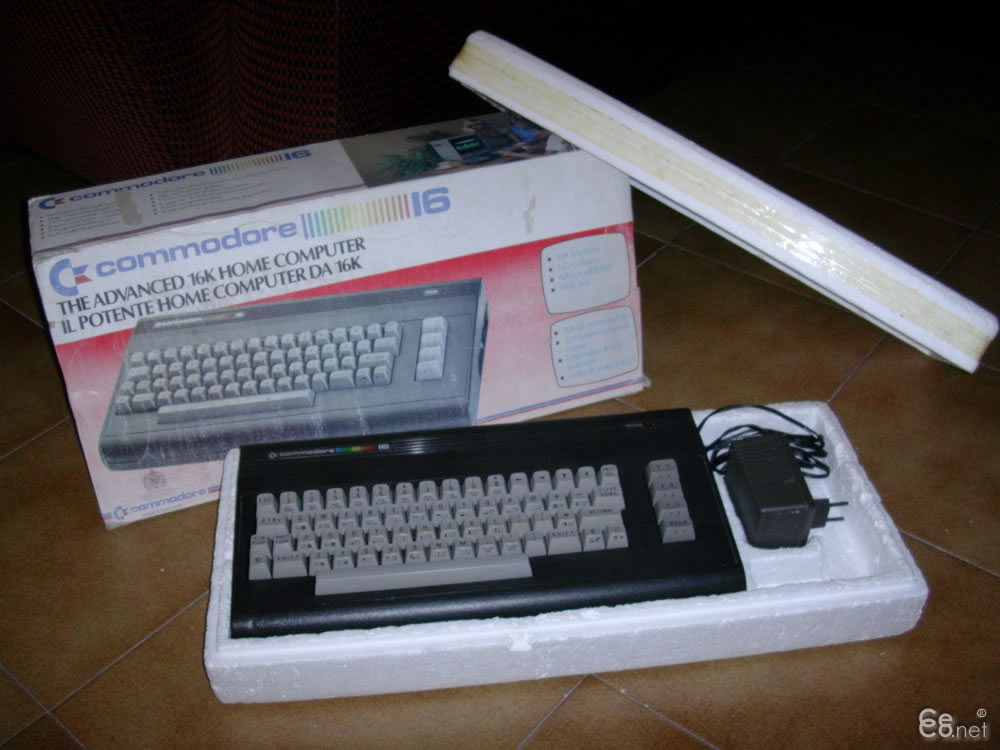
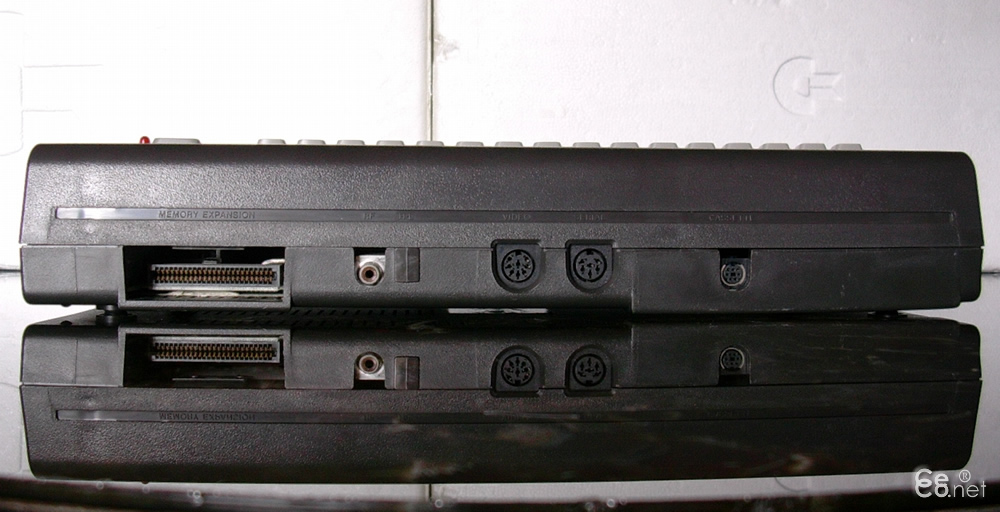
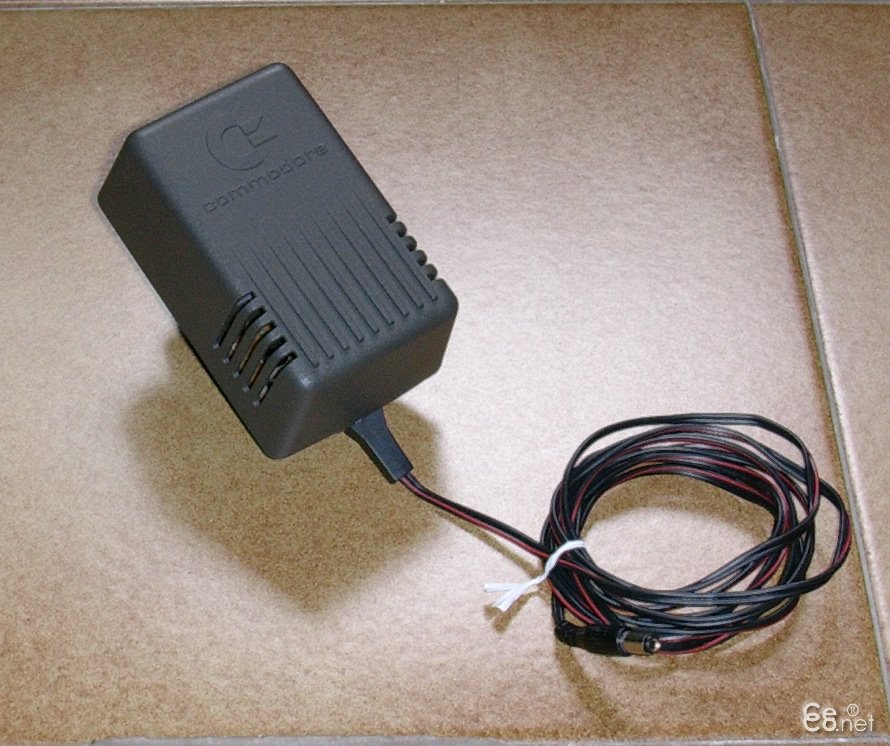
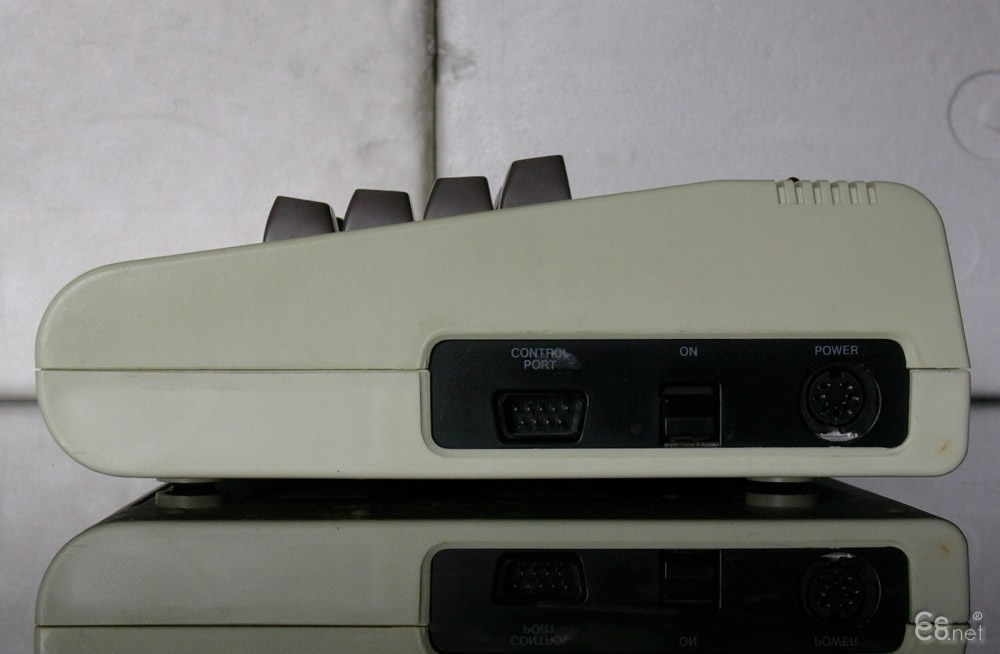
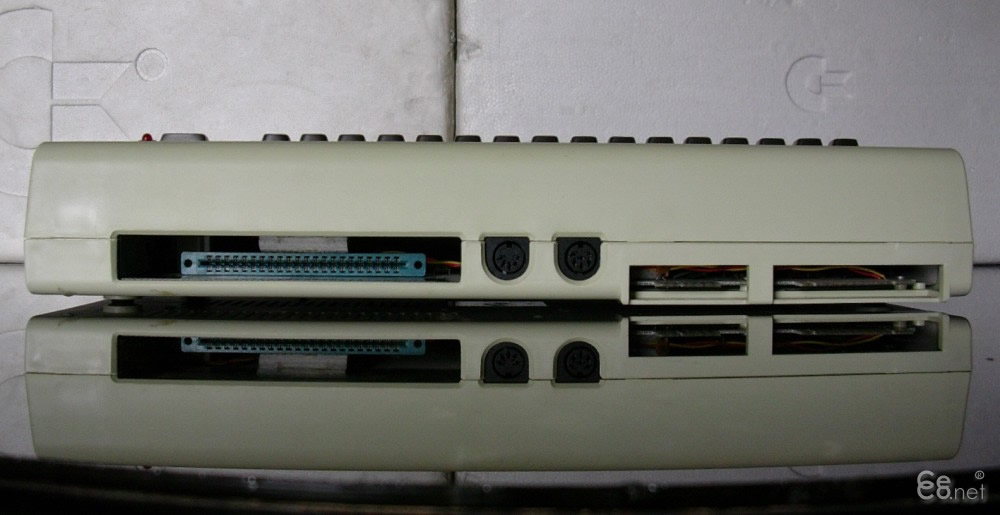
The Commodore 64 (first series) in its original box including a power supply.
 Technical
Production year1982
output price
660,000 Lira
CPU: CSG 6510
1 MHz clock speed.
RAM: 64 kilobytes
ROM: 20 kilobytes
C64 Kernal
CBM Basic 2.0
Video: MOS 6569 "VIC-II"
320 x 200 Hi-Resolution 40-column text
palette of 16 colors.
Audio: MOS 6581 "SID"
3 stereo voices, the ability of synthesized sound / digital
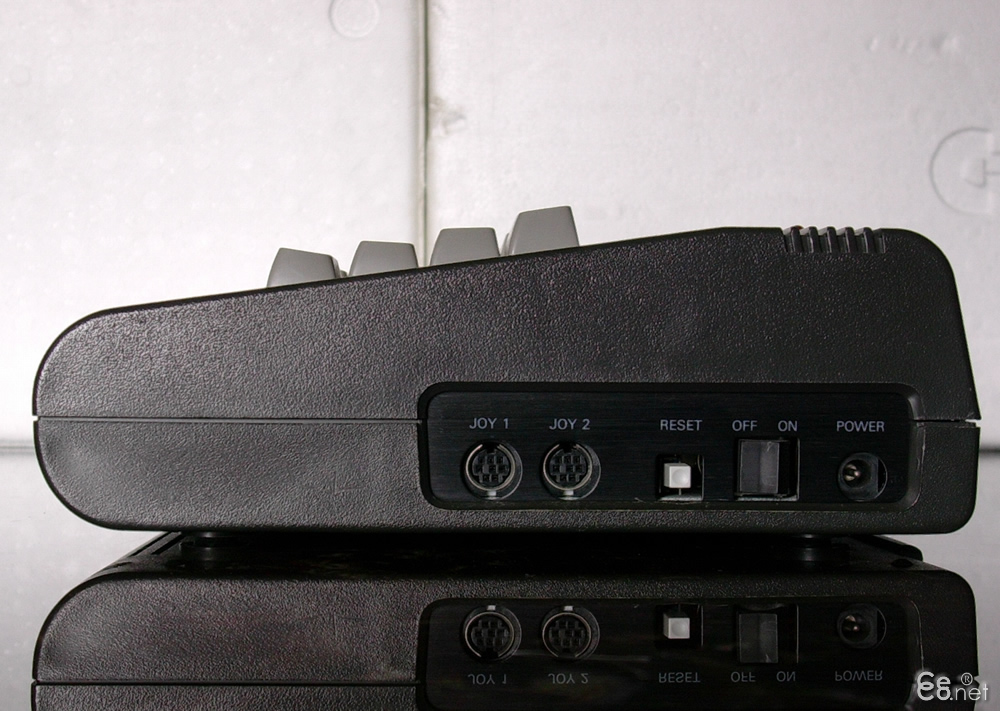
Ports: MOS 6526 CIA x2
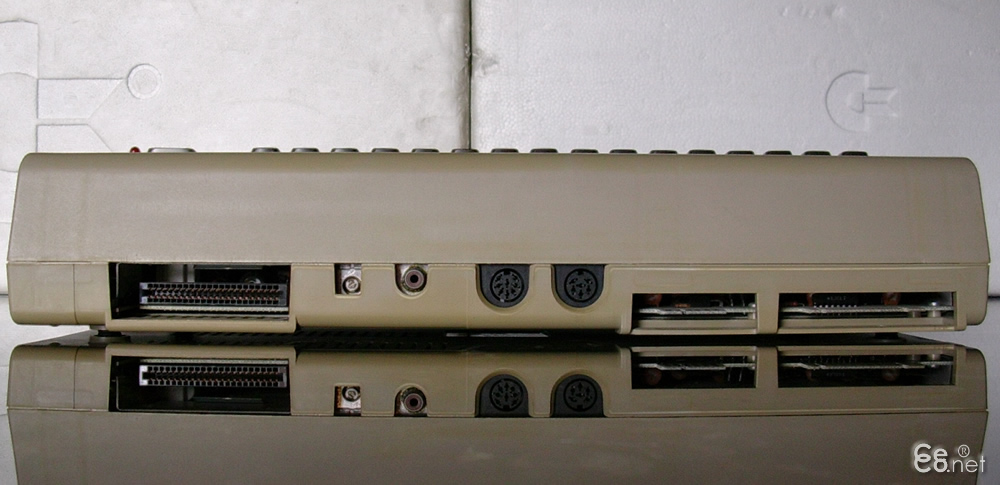
2 Port Joystick / Mouse
Round DIN CBM Serial
Male Female edge-connector CBM Datasette
Male edge-connector parallel programmable "User"
Round DIN CBM Monitor
Femmina edge-connector C64 espansione
Bottone accensione
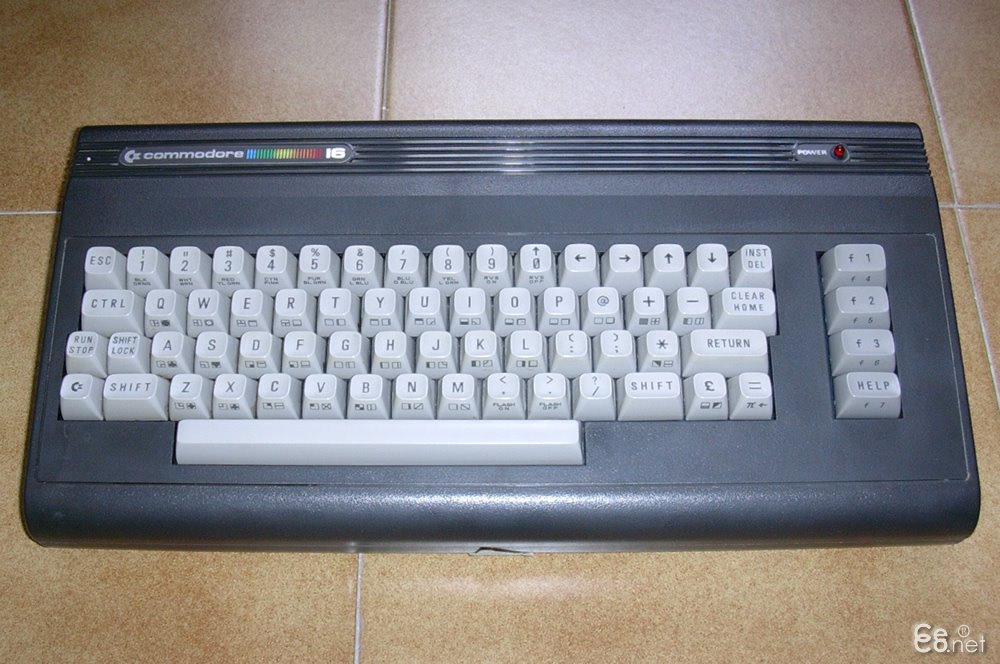
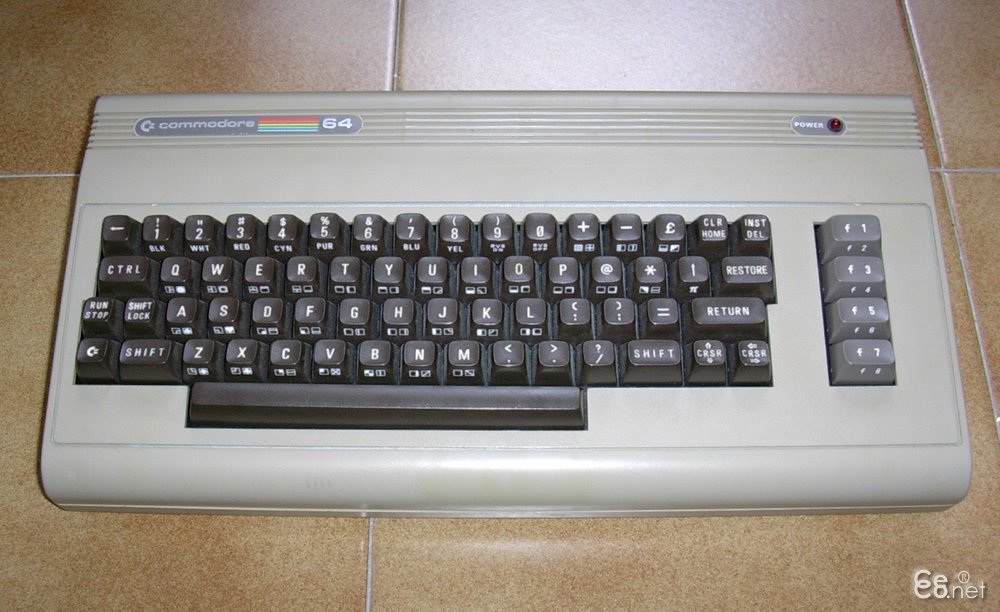
Tastiera: Full-sized 62 key QWERTY
8 tasti funzione programmabili
2 tasti direzionali per cursore
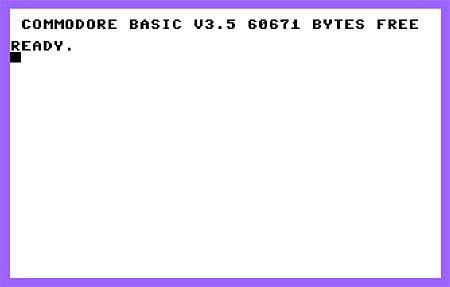
Schermata video

Vista frontale, laterale e retro

Alimentatore

Cenni strorici
Il Commodore 64 è un home computer ci casa Commodore molto popolare negli anni ottanta. Il nome adottato dalla casa costruttrice fu inizialmente Vic-30, ma prima della distribuzione venne cambiato in Commodore 64.Risulta essere il modello di computer più venduto al mondo , record che si trova anche nel Guinness dei primati: nel 1986 furono venduti più di 10 milioni di esemplari in tutto il mondo . Fu commercializzato fino al 1993, quando le unità vendute furono appena 700 mila.
La semplicità d'uso e facilità di programmazione di questo nuovo computer era superiore sia ai suoi precedessori (il PET e il VIC-20) sia agli altri home computer concorrenti. Grazie a ciò e al suo prezzo di vendita, in breve tempo divenne il computer più venduto nella storia dell'informatica.
Nel giro di pochi anni il Commodore 64 entrò in milioni di case, stabilendo un incredibile Sales success: If you want this computer during the first half of the '80s can not remember the broadcast via television advertising slogan: "Compramelo father, so we play too ..". In fact, the Commodore 64 allowed anyone to learn to write simple or complex programs, or left to the imagination with the incredible availability of exciting games. The developers of the Commodore 64 took advantage of every bit of available memory, creating programs that seem impossible today if you think that the processor ran at just over 1 Mhz and the memory was only 64 Kb
The Commodore 64 was initially built using the same houses of the Vic-20 to maintain low production costs. After some years, the Commodore slightly changed the aesthetics of the computer along with other minor changes, renaming 64C.
Origins and details
In January 1981, the subsidiary of Commodore for the design of integrated circuits, the MOS Technology Inc. was the design of graphics chips and sound for the new generation of game consoles. The design work for the chip was completed in November 1981, but the design of the console was canceled after a meeting with the president of Commodore, Jack Tramiel. Tramiel wanted chips form the basis for a computer with 64 KB of RAM, which was then twice the amount of RAM available for many of the personal computer in late 1981. Although 64 Kb RAM were very expensive, Tramiel knew that DRAM prices were falling and that would eventually dropped to an acceptable level before moving to full production. The design team was given less than two months to develop a prototype that could be shown at the Consumer Electronics Show in winter, in January 1982. The C64 made an impressive debut as recalled by David A. Ziembicki: "Everything that we saw at our booth were the people dell'Atari with his jaw wide open, saying 'How can you do it for only $ 595?'." The construction cost of each C64 is estimated at about $ 135, thanks to vertical integration and, more crucially, the advantages of the manufacture of chips MOS Technology. This made possible a wide margin with which to work.Winning the War of the market
The C64 faced a wide range of competing machines, and since its introduction in August 1982. With an impressive list price and with its advanced hardware, quickly surpassed many of its competitors. In the United States the greatest competitors to the C64 were the Atari 800 and Apple II. The Atari 800 was very similar in terms of hardware, but it was very expensive to build, which forced Atari to shift its production in East Asia. Atari also forced to redesign their cars to be cheaper, giving light to the line of 400/800XL. The now old Apple II could not compete with the hardware of the C64, but was very extensible through its internal expansion slot, a feature that the C64 did not have.
In the UK the main competitors to the C64 were the British Sinclair ZX Spectrum and Amstrad CPC. Released a few months before the C64, and sold almost half its price, the Spectrum quickly became the market leader. The C64 will compete in popularity with the Spectrum in the second half of the 80's, survived the same when he was no longer in production in 1992.
The key to the success of the C64 were the aggressive marketing tactics that result in sales at department stores, discount stores and toy stores, addition to the network of authorized dealers. This allowed him, as his predecessor, VIC 20, to compete with game consoles.
In 1983, the Commodore gave the United States, an incentive of $ 100 to buy a C64, withdrawing any computer or game console. The success of the VIC-20 and C64 also contributed significantly to exit the scene of the Texas Instruments home computer from the field (see TI-99/4A) and the infamous crack of video games of 1983
A demoscene active
At the time of its introduction, the graphics capabilities of the C64 were equaled only by the family Atari 8-bit. It was the period in which most part of the IBM PC-compatible graphics cards were only in text mode, green phosphor screens and a crackling sound from the tweeter small low-quality interior. Thanks to its advanced graphics and its sound, the 64 is often credited with having started the computer subculture known as the demoscene (see demo for the Commodore 64). In the new millennium is still actively used as a demo machine, especially for the music (its sound chip is even used in special sound cards for PC). For those who are not a huge fan, however, the C64 lost the leadership when they were released on 16-bit Atari ST and Commodore Amiga in the mid 80s.
The demoscene è lontana dall'essere morta, perfino a 20 anni dalla nascita del C64. Sono anche sviluppati nuovi giochi (alcuni dei migliori disponibili tramite Protovision, si vedano i collegamenti esterni). Uno dei nuovi giochi che val la pena citare è probabilmente Enahnced Newcomer, un gioco che è stato sviluppato in quasi 10 anni.
Una nota triste è la differenza tra i C64 PAL e quelli NTSC. Questi due standard televisivi causano problemi di compatibilità tra le versioni Statunitensi/Canadesi e quelle del resto del mondo. Come conseguenza, la maggior parte dei demo girano solo su macchine PAL.
Note sull'hardware
Il Commodore 64 usava il microprocessore 6510, con 64 KByte di RAM e 20 KByte di ROM con KERNAL the (acronym, acrostic or more likely, by Keyboard Entry Read, Network, and Link) and the CBM BASIC 2.0: audio and video were managed by two separate chips. Since the 6510 processor could only address 64 Kbytes of memory in total, 20 Kbytes of RAM were hidden from ROM. A register allows you to map hidden in the RAM memory excluding the ROM, which is very useful in assembly programs that did not need BASIC interpreter. The hardware design of the original Commodore 64 was the work of a group of about a dozen engineers who subsequently left the Commodore.
Microprocessor The microprocessor used was MOS Technology 6510, an amended version of 6502 con alcuni segnali hardware aggiuntivi per il registratore a cassette, che veniva gestito direttamente dal microprocessore. La frequenza di clock era pari a 0.9875 MHz. Le istruzioni più semplici prendevano almeno 2 cicli di clock, quelle più complicate 5. Quindi il Commodore 64 aveva una potenza di calcolo di una piccola frazione di MIPS. Poteva però delegare molti compiti ai due chip aggiuntivi descritti di seguito (più il CIA, Complex Interface Adapter = Adattatore di interfaccia complessa). Questa caratteristica, cioè l'architettura a coprocessori, costituì la base sulla quale venne in seguito sviluppato il primo computer Amiga dalla Hi-Toro, il quale venne poi commercializzato ed ulteriormente sviluppato dalla Commodore e spopolò in the '80s and early '90s with the following models.
There are also add-in card Z-80, making it possible to use the Zilog Z80 (evolution, Intel 8080A) on the Commodore 64. One of these was the cartridge CP / M Z80 Commodore that allows you to use this OS (version 2.2) by a combination of emulation hardware / software. The video chip
The Commodore 64 had a video chip (VIC-II) that could produce 16 colors (a greater number of colors was achieved with special software algorithms). It had a maximum resolution of 320 x 200 points in the "hi-res" (2 possible colors for each cell 8 x 8), and 160 x 200 in the "multicolor" (4 colori possibili per ogni cella 8 x 8). Il modo testo forniva una visualizzazione di 40 colonne per 25 righe. Il font di caratteri di default era modificabile (bastava ordinare al circuito grafico di prelevare le definizioni dei caratteri dalla RAM anziché dalla ROM). Il chip gestiva fino a 8 sprites hardware, cioè delle forme grafiche facilmente gestibili dal chip per ottenere immagini e animazioni, disegnate sopra allo schermo tradizionale. Il VIC-II era capace di generare un interrupt in una qualunque linea di scansione del video desiderata. Questo permetteva al processore centrale di riprogrammarlo "al volo" in modo da usare un set di parametri diverso per zone diverse dello schermo, per esempio per riutilizzare un'altra volta gli 8 sprites, avendone così 16 or more also available on the screen (over 50 in some cases). The registers of the VIC-II were in RAM memory-mapped processor, which could be read and written like any other memory location.
sound chip
audio support exceeded all computers in the same class. The basis was the 6581 SID-chip, designed by Bob Jannes (the designer of the VIC-20), who could play three entries hardware, allowing the reproduction of human voice without additional hardware (see eg the "SAM" - Software Mouth = "software language"). At the level of synthesis, the SID sounds built from three basic waveforms, plus ADSR. Among these waveforms sadly missed the sine wave. The number of entries could be "increased" by software techniques. Even the control registers in the CIS, such as the VIC-II, were memory-mapped (as the CIS, as well as the VIC-II, the CIA, etc. ... an interface adapter, which is mapped into memory). The CIS could also be sampled analog signals with a resolution of 4 bits.
In the '90s and 2000
In 1990, the C64 was released as a game console, called the C64 Games System (C64GS). It consisted mainly of a board of C64 modified to orient the connector for the cartridges in an upright position to allow the insertion of the same from above. A ROM amended it replaced the interpreter BASIC, to show a startup screen informing the user to insert a cartridge. Needless to say, C64GS was another commercial failure for Commodore, and was not even released outside of Europe. In 1990/91, it was designed a potential successor advanced C64, the Commodore 65 (also known as the "C64DX"), but was never released.
summer of 2004, after an absence from the market of more than 10 years, PC manufacturer Tulip Computers BV (owners of the Commodore brand since 1997) announced the C64 Direct-to-TV (C64DTV), a TV game built into a joystick based on the C64 with 30 games in ROM. The C64DTV designed by Jeri Ellsworth, a self-taught computer designer, was similar in concept to other mini-console that had been a decent success at the beginning of the decade, based sull'Atari 2600 or sull'Intellivision. The product was advertised on QVC in the U.S. in holiday season 2004.
Even today (2005) new hardware is being developed by enthusiasts, such as Ethernet cards, interfaces for hard disks and Flash Card Usually the new hardware is available through Protovision (see external links).
[edit] Hardware revisions
The cost reduction was the driving force for the C64 revision of the motherboard. Reduce the cost of production was vital to the survival of the Commodore during the war prices and the lean years of the 16-bit era. The original C64 motherboard (based on NMOS) had undergone two major redesigns (and numerous sub-revisions) that changed the location of the VIC-II chip, SID and PLA. Initially, a large share of the cost was lowered by reducing the number of discrete components used, such as diodes and resistors.
The first board of C64. (Rev A PAL 1982)
Enlarge
The first board of C64. (Rev A PAL 1982)
The VIC-II was produced by MOS technology to 5 micrometers, with a frequency of 8 MHz at a frequency so high, generating plenty of heat, necessitating the use of a MOS technology integrated ceramic DIP (CERDIP called). The integrated ceramic was more expensive, but dissipate heat more effectively than plastic.
After a redesign in 1983, the VIC-II was produced in a plastic plate DIL, greatly reducing costs, without solving the problem of heat. Without a ceramic plate, the VIC-II required the use of a heat sink. To avoid additional costs, the metal shield electromagnetic was used as a heat sink for the VIC, although not all units were equipped with this type of protection. Many Commodore 64 sold in Europe were provided with a protective cardboard, covered with a metallic layer. The effectiveness of the protection was very dubious, and in the worst possible way as it worked isolante, bloccando il flusso d'aria trattenendo il calore generato dai chip SID, VIC e PLA.
La SID fu fabbricata usando NMOS a 6 e 7 micrometri. Il prototipo della SID ed in alcuni modelli pre-produzione avevano una piastra in ceramica DIL, ma sono estremamenti rari (al contrario del VIC-II). La maggior parte delle piastre dei SID erano prodotti in plastica.
Nel 1986, la Commodore fece l'ultima versione della scheda madre "classica". Era identica alla versione del 1984, ad eccezione dei 2 chip DRAM per la memoria, anziché gli originali 8.
La scheda madre del C64C ("C64E" Rev B PAL 1992)
Ingrandisci
La scheda madre del C64C ("C64E" Rev B PAL 1992)
Dopo l'uscita del C64C, MOS Technology began using HMOS technology in the C64 chipset. Benificio The most obvious was that it required less voltage and thus producing less heat. This improves the efficiency of the SID and VIC-II chip. The new chipset was renamed as 85xx.
In 1987, Commodore released the C64C with a totally redesigned motherboard. This motherboard was known as a "short form". The new board had the new HMOS chipset, with the new 64-pin chip PLA. The new "SUPERPLATE" incorporated many components and chip transistors. The 2114 color RAM was integrated in the latest version of the PLA.
A curious note comes from some of the Commodore 64 manuals showing the picture of a sample, probably a prototype, with a square-shaped buttons and screen prints quite large, such as those typical of the PET 4000 series. Unlike the VIC-20, which was actually produced with this keyboard, there's no evidence of such a variant of the Commodore 64 of the specimens of production. Download
Kernal ROM Image (. Bin)
BASIC ROM image (. Bin)
Char ROM image (. Bin)
Commodore 64 PLA information (. Txt)