
The Commodore 128 in its original box including a power supply.
Technical
Year 1985 productionoutput price
990,000 Lira
CPU: CSG 8502 and Z-80
1 or 2 with 8502 MHz clock speed.
3 MHz clock speed with Z-80
RAM: 128 kilobytes
CBM Basic 7.0
CP / M 3.0
Video: MOS 8564 "VIC-II and MOS 8563 CTRC
Text Mode 1: 40 column text mode
Test 2: 80-column text
palette of 16 colors.
two types of resolutions: 320 x 200, 640 X 200
Sound: MOS 8580 "SID"
3 entries stereo sound capabilities of synthesized / digital
Ports: MOS 6526 CIA x2
2-Port Joystick / Mouse
Round DIN CBM Serial
Male Female edge-connector CBM Datasette
Male edge-connector parallel programmable "User"
Round DIN CBM Monitor
Male edge-connector C64 expansion
reset button to restart the system keyboard port
button ignition
Keyboard: Full sized 93-key QWERTY
14 numeric keys on the keypad
8 programmable function keys more keys help
4 direction keys plus 4 buttons on the cursor pad
screen video
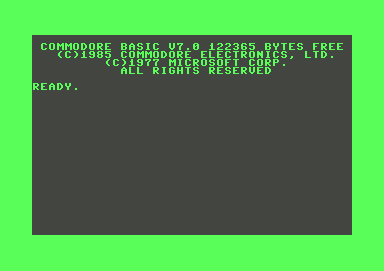
screen video mode 128

Schermata video modalità cp/m
Vista frontale, laterale e retro


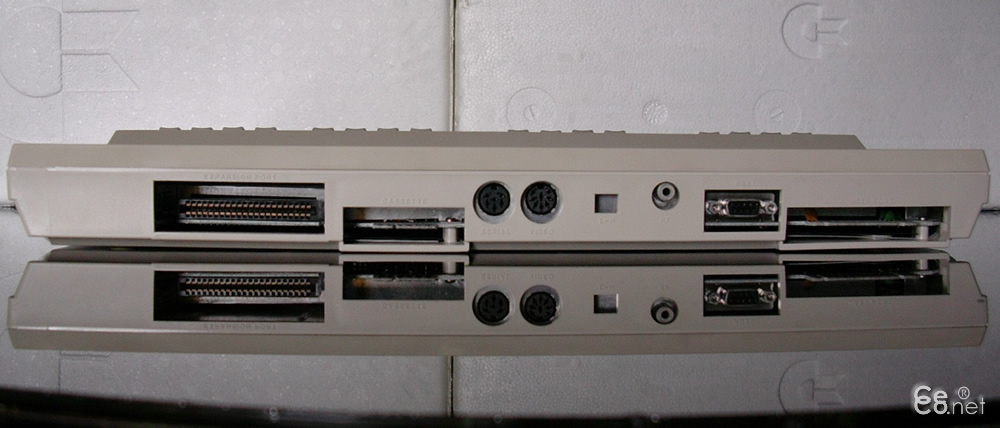
Alimentatore

Cenni strorici
Il Commodore 128 è stato un modello di computer della CBM Commodore Business machines commercializzato nel gennaio del 1985, tre anni dopo il suo celebre predecessore, il Commodore 64.Il C 128 nacque dopo lo sfortunato tentativo del 1983 di rimpiazzare il VIC-20 e il Commodore 64 con le macchine della serie TED (dal nome della particolare componentistica), ossia il Commodore 16 (detto anche C16) e il Plus 4, the latter for professional use: these machines were not compatible with the two predecessors, however, and could not take advantage of the great mass of programs and games written for the C64. Given the poor reception of the two new machines on the market and realizing the error committed, the management tried to fix with Commodore Commodore 128, which was compatible with the C64 but to implement some of the advanced features of TED machines, such as BASIC 3.5 which was further developed and brought to version 7.
Thus the C 128 was launched by Commodore in 1985 at Las Vegas Computer Show. By the time he was a computer with remarkable features, but soon, as has been said was abandoned because of the incredible success of 16-bit machines and especially the new platform recently acquired by Commodore, the Amiga.
The Commodore 128 was equipped with a processor, though more powerful than the C64 (the 6510) was compatible with it and could run around the park software older brother and more widespread. The new hardware features also promised, on paper, a broader range of professional and recreational uses: the graphics offered a 640x200 mode (using the new chip VDC) and the sound was 3 channels. However, incredibly, just the graphics of the new video mode (640x200 - 80-column text) was the major weakness of the C128: sprite if it did not support the 40-column mode, and the only way to access the video memory of the VDC was addressed individually any location through an intricate system of two records, which made it very slow graphics operations: the development of games with graphics 640x200 mode was impossible on the C128 in native mode (which is why a software company, Walrusoft, created the BASIC 8.0, an exceptional extension to the BASIC that allowed easy management of VDC).
The Commodore 128 could also count on a parallel processor for Zilog Z80 which allowed the use of the operating system CP / M and allowed access to the vast park programs written for this OS to allow
the CP / M operating performance worthy of the Commodore 128 with a built-supported mode 'accelerated transfer of data on the disk serial bus (burst mode) and for this purpose were proposed for two new units this computer' on the disc, 1570 to sided and double-sided 1571, to support writing in MFM format as well as in the previous GCR.
Operating Systems
BASIC resident of 128 C, called BASIC 7.0 integrates advanced graphics capabilities and the ability to control the audio portion. The Commodore 128 is notable for being produced in both the classical model with U.S. keyboard is in International versions (German and Italian the most 'known by us). The C 128 and 'too the first Commodore model in which the startup screen clearly shows the copyright of the Microsoft BASIC language. Another first time the Commodore 128 and 'an easter egg, a hidden message in the system, containing among others the names of designers, called with the statement SYS32800, 123,45,6. The ignition system starts the search for bootable software combined with the first 'disc. This feature, also a news 'for the Commodore computer, and' typical system CP / M but was later used in other software for the 128, including an Italian creation that could force the loading of programs for Commodore 64 and the activation of the relevant mode 'of operation. Departure occurred, as well as for power, when pressing the reset command and the basic boot. The Basic 7.0, however interesting, was also incomplete commands quit off and generate the error? UNIMPLEMENTED COMMAND ERROR. The names of the two commands, respectively, suggest the possibility 'of a resident operating system discs, as on the Atari 800 and the like, and opportunity' to allow the computer to go out alone. It is highly likely to be withdrawn in the design phase of features to reduce costs.A separate deserves CP / M. This was then an operating system widely known and highly appreciated (a real "industry standard"). CP / M inspired 'from which derived the QDOS operating systems IBM PC-XT, the IBM PC-DOS and MS-DOS from Microsoft. Unfortunately, the use of CP / M on the C128 was very sporadic and limited: the CP / M was mainly a DOS, an operating system that is based on records, and could not function without them. Most of the purchasers of C128 bought this computer just like a C64 "with a plus", and especially to play with the thousands of games available for C64, waiting to see out a new generation of games for C128, that given the limitations of the graphics there was. In addition, the compatibility 'between the various hardware when spinning CP / M was not absolute, because of a babel of formats never totally routed between the discs from different manufacturers. The dual-drive faccia 1571, espressamente concepito per il Commodore 128, consentiva la lettura di una parte dei dischi di tali sistemi, oltre a supportare naturalmente un proprio formato specifico.
Per il C 128 venne creata una particolare versione del Sistema Operativo ad icone GEOS, che già aveva avuto fortuna col C64, e che venne denominato sulla nuova macchina GEOS 128. Questa versione specifica permetteva l'uso della grafica 640x200 tramite il secondo chip video, quello per l'uscita a 80 colonne, ed il bank switching necessario a sfruttare le espansioni di memoria da 128KB e 512KB ufficiali Commodore (mod. 1700 e 1750). Da notare il fatto che, dal 2004, le versioni GEOS per Commodore, sono state rese freeware, quindi liberamente scaricabili, dal site of the house that holds the rights. Pros and cons
The high compatibility with the Commodore 64 is due to the fact that the most important components of the C64, as the VIC, the CIS and the ROM BASIC 2.0 and KERNAL of 64 are also present in the C128 and due to the fact that the MOS 8502 CPU is fully backward compatible with 6510. C128 can be connected to all devices of the C64, including cartridges, that start automatically C128 in 64 mode.
Sometimes (very rare in reality) but differ in mode 64 is compared to a C64 "true", and this sometimes generates blocks, mainly due to your use of the software address di memoria del chip MMU, visibile al software anche in modalita' 64.
Ciascuna delle due CPU può indirizzare al massimo 64 kilobyte, quindi i 128 kB di RAM possono essere visti solo dopo essere stati suddivisi in due banchi e commutando fra essi.
Risultati
Questo computer nacque con grandi pretese. La pubblicità lo rappresentava infatti come il terrore degli IBM compatibili o un Macintosh killer, ma il C128 non ebbe una grande fortuna. Possedeva di base la stessa quantità di memoria del Macintosh 128K e più capacità grafiche e sonore di un IBM compatibile dell'epoca, poteva poi anche accedere a una vastissima quantità di software, quello già scritto per il C64 e quello del sistema Operativo CP/M, prior to the MS-DOS and inspired him. The low market penetration and 'partly due to the fact that, at launch, the standard CP / M was already' dying commercially in favor of MS-DOS. The nature of "cross" of the computer, a little 'home and a little' personal, with the limitations of the first and, once used as such, the cost of the second, contributed to accentuating this effect.After the success of the Macintosh, Apple launched new models, including the Macintosh Plus, with more memory (1 MB) and a SCSI interface that allows the addition of hard drives and other peripherals, and outperforming the Commodore. The response of Commodore, Atari plus pressed by the competition of already 'in hand to spill founder Jack Tramiel, was the acquisition of Hi-Toro and Technology of the whole project then console gaming Amiga. The latter features some cutting-edge multimedia and was subsequently developed as a computer. All this did diminish rapidly interest in the Commodore 128, which was soon forgotten except by a few devoted users and fans of today retrocomputing.
Download
Kernal ROM Image (. Bin)Char ROM Image (. Bin)
7 HI BASIC ROM Image (. Bin)
7 THE BASIC ROM Image (. Bin)
Z80 ROM Image (. bin)
Commodore 128 PLA info (.zip)

